
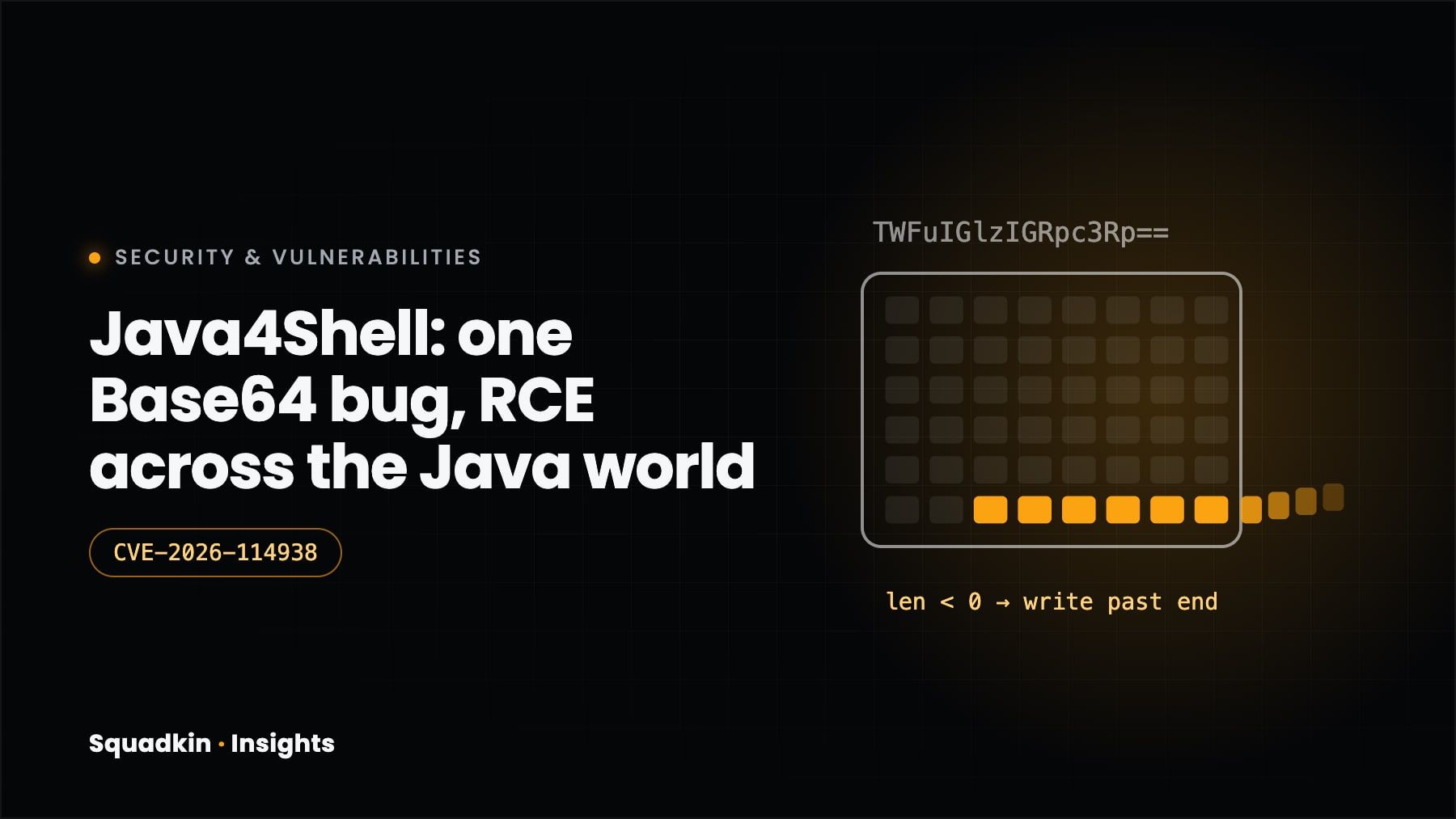
Security researchers at Calif have disclosed Java4Shell (CVE-2026-114938), a critical bug in OpenJDK, the engine almost every Java application runs on. It is rated 9.2 (Critical) under CVSS 4.0. OpenJDK and Oracle released fixes on 17 November 2026.
The name is a nod to Log4Shell, and the reach is similar: one flaw in a shared building block puts a long list of well-known business software at risk.
What is affected
- OpenJDK 17.0.6 and later, and every Java build made from it: Amazon Corretto, Eclipse Temurin, Microsoft, Azul Zulu, Liberica, SapMachine, Red Hat and Oracle Java SE / GraalVM.
- Only x86-64 servers whose CPUs support AVX-512 VBMI. That covers Intel Ice Lake, Sapphire Rapids, Emerald Rapids and Granite Rapids, and AMD Zen 4 or newer: most modern cloud servers.
- ARM servers (such as AWS Graviton) are not affected.
What goes wrong
To decode Base64 fast, Java uses a hand-written routine that runs special CPU instructions. When it is given badly formed Base64 with padding, a length calculation goes negative and the routine writes past the end of its memory buffer. The bug is in the JVM’s native code, not in Java code, so the usual Java safety guarantees do not help.
Base64 is everywhere: login tokens, API payloads, file uploads. Calif showed remote code execution without logging in on default installs of Keycloak, Jira, Confluence, Artifactory, Jenkins and PingFederate, and code execution after login on Kafka, Solr, Elasticsearch, Gerrit and Spinnaker. The same bug can also leak memory contents, in the style of Heartbleed.
How it was found
A researcher used OpenAI’s Codex to audit the HotSpot JVM. The bug turned up in about an hour, with a first working exploit two hours later, for less than $200 of AI usage. Expect findings like this to keep coming faster.
What to do now
- Update Java on every server to the November 2026 OpenJDK or Oracle release, then restart the applications that use it.
- Update bundled runtimes. Products like Jira, Confluence and Jenkins Docker images often ship their own Java. Check vendor advisories and update those too.
- If you cannot patch today, start Java with
-XX:-UseBASE64Intrinsicsto switch off the fast Base64 routine. On x86-64 only,-XX:UseAVX=2also works. Do not use that flag on ARM: Java will not start. - Prioritise internet-facing services such as single sign-on (Keycloak, PingFederate), Jira and Jenkins.
Calif is holding back the exploit details for each product until more people have updated, so now is the time to patch.
Not sure if this affects you? Talk to us and we will check your Java services and plan the update with you.
Source
This article summarises Java4Shell: Write once, RCE everywhere, published by Calif on 17 November 2026 (research by Quang Luong). Read the original for the full technical details.