
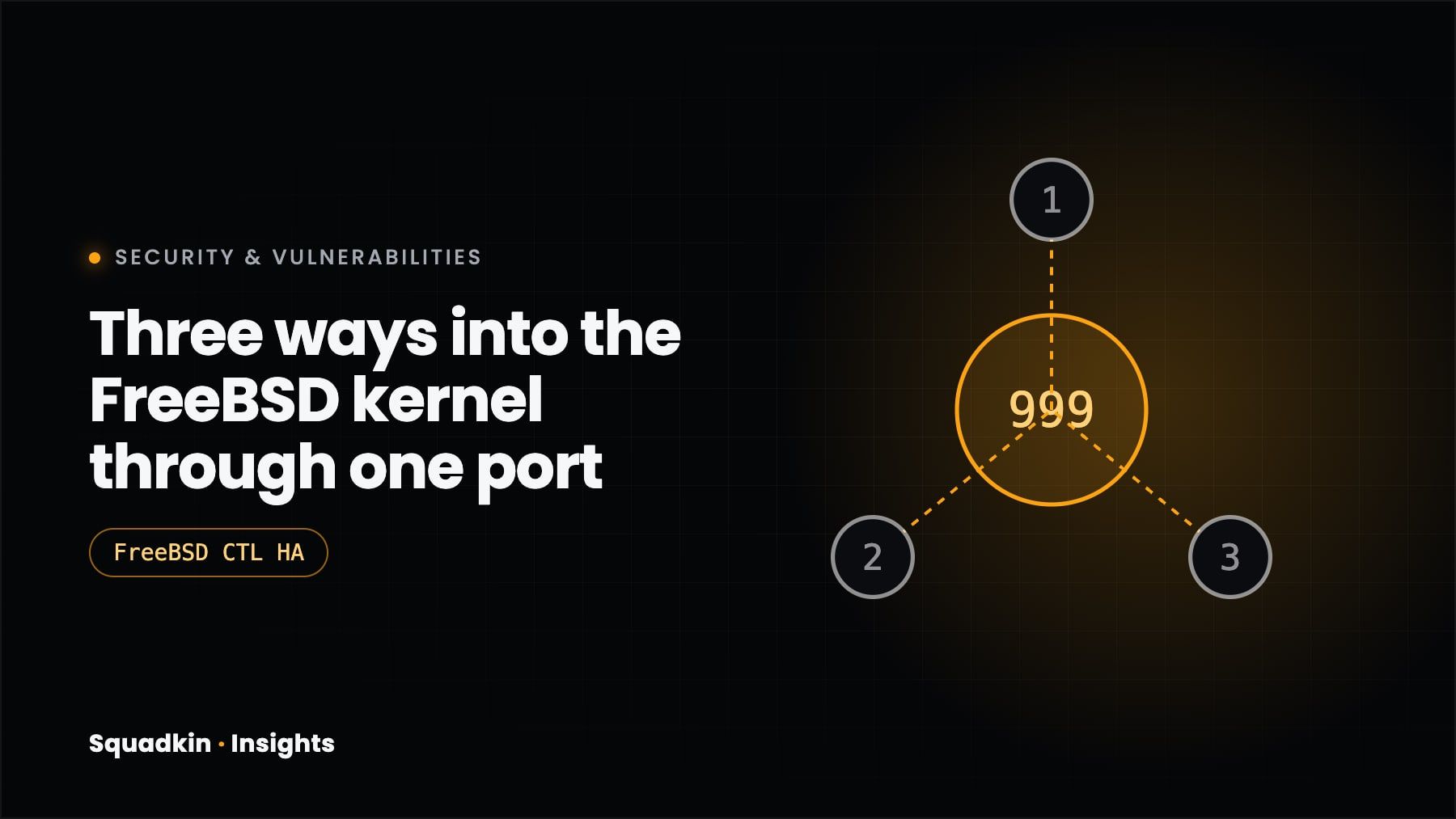
FreeBSD’s CAM Target Layer (CTL) turns a server into network storage. In high-availability (HA) mode, two storage controllers keep each other in sync over a TCP link, by default on port 999. This setup is used by systems such as TrueNAS Enterprise HA clusters.
Calif found that this link has no authentication at all and passes raw kernel memory addresses back and forth. Anyone who can connect to the port is treated as the trusted partner controller.
Three ways in
- FreeBSD-One: memory addresses in HA messages are used without checks, giving an attacker read and write access to kernel memory.
- FreeBSD-Two: a second unchecked address in the data-transfer handler lets an attacker write to memory.
- FreeBSD-Three: a heap overflow, where an unchecked count overruns a fixed 64-byte buffer.
Each one alone gives remote kernel code execution and a root shell, with no login, to anyone who can reach port 999.
Found by an AI audit
The bugs came from an AI-led audit that began in March 2026 with a single prompt to Claude Code. Specialist agents reviewed over 35 kernel source files across nine subsystems, and the audit produced 39 confirmed findings. These three were turned into exploits and checked by Calif’s researchers.
No code fix
Calif reported the bugs in March and April 2026. Because the HA protocol was built with no authentication, FreeBSD chose to document the risk rather than change the code: the ctl(4) manual page now says HA must only be set up on trusted networks.
What to do now
- Find out if you use CTL HA, for example a dual-controller TrueNAS Enterprise system, or
kern.cam.ctl.ha_peerset on FreeBSD. - Put the HA link on a dedicated, isolated network, ideally a direct cable or private VLAN between the two controllers.
- Block port 999 at the firewall from every other network, including the rest of your LAN.
- Ask your storage vendor how their product protects the HA link.
Not sure if this affects you? Talk to us and we will check your storage network and plan the update with you.
Source
This article summarises The Taking of FreeBSD One Two Three, published by Calif on 6 August 2026 (research by Ryan A.). Read the original for the full technical details.